
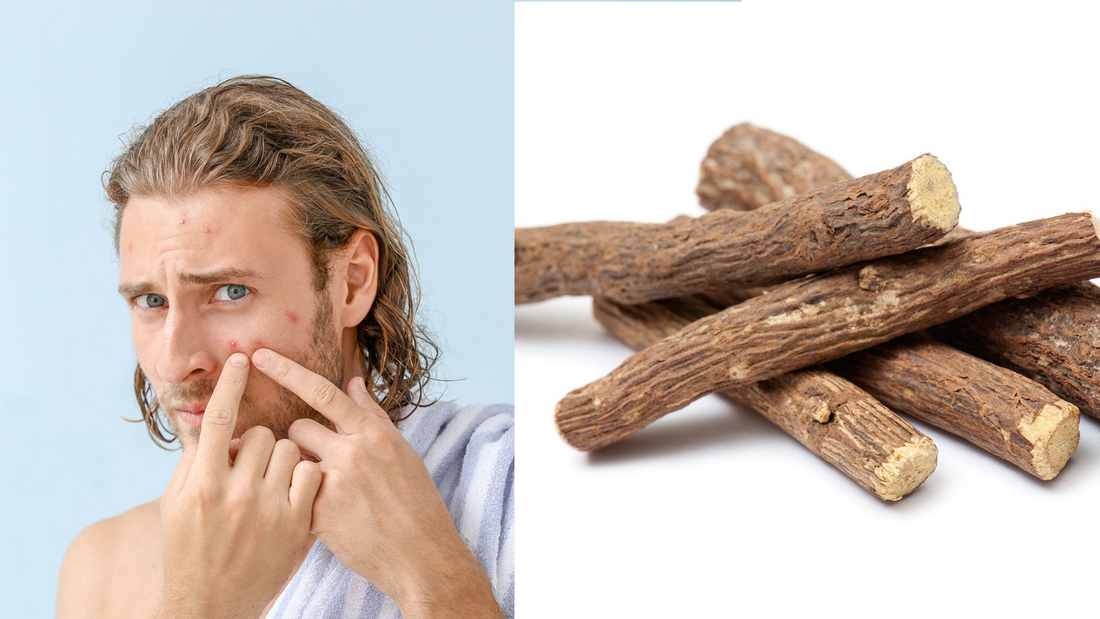
Licorice Root for Acne: Anti-Dark Spot & Anti-Inflammatory
Licorice root contains a compound called glabridin that blocks the enzyme responsible for producing melanin after sun exposure or inflammation — which is exactly why it works against dark spots and post-acne marks. Unlike aggressive brightening agents, it targets pigmentation without disrupting the skin's barrier or causing the irritation that makes ingredients like hydroquinone a dealbreaker for sensitive skin types.
It's also quietly anti-inflammatory, which matters more than most people realize. Acne leaves behind hyperpigmentation partly because of the inflammatory response itself — so an ingredient that addresses both the inflammation and the resulting discoloration is genuinely useful, not just trendy.

In addition to its dark spot fighting ability, licorice root is also a powerful antioxidant. Antioxidants fight off free radicals. Free radicals contribute to signs of aging and their production increases the speed at which signs of aging appear. By applying licorice root externally, one can battle the time and tide of aging by reducing the presence of free radicals. This will help reduce the signs of aging as well as keep your skin healthy and forming new cells as it has always done (potentially slowing the signs of age).
The Topper
Licorice root tops off its list of benefits with anti-inflammation. Much of the anti-inflammatory effects can be attributed to the flavonoids in licorice root (its what makes black licorice so tasty). However, there is another molecule in licorice root called "licochalcone A." This molecule can disrupt the process which starts inflammation happening, thus preventing inflammation before it starts.
Licorice root's host of benefits made it a natural inclusion in our blissani Naturals Clear toner. Sweep away impurities, reduce inflammation and signs of aging the natural way with our blissani Naturals Clear line. Each of our natural luxury beauty products is vegan-friendly, cruelty-free and non-toxic.

For Further Reading on Licorice Root:
National Library of Medicine: https://pubmed.ncbi.nlm.nih.gov/24201019/
Frequently Asked Questions
Common questions about this topic
Can I use licorice root with other acne treatments like benzoyl peroxide or salicylic acid?
Yes, licorice root is gentle enough to layer with most acne treatments. Since it works through a different mechanism (targeting inflammation and pigmentation rather than killing bacteria), it complements rather than competes with benzoyl peroxide or salicylic acid—making it ideal for treating active breakouts while preventing dark spots simultaneously.
How long does it take to see results on existing acne scars and dark spots?
Most people notice a visible reduction in post-acne marks within 4-8 weeks of consistent use, though deeper or older hyperpigmentation may take 8-12 weeks. Results depend on the depth and age of the marks, so patience is key—licorice root works gradually but effectively because it addresses the root cause rather than just masking discoloration.
Is licorice root safe for all skin types, including those sensitive to other brightening ingredients?
Licorice root is particularly well-tolerated by sensitive skin because glabridin works without disrupting the skin barrier or causing the irritation common with harsher brighteners like hydroquinone. Its anti-inflammatory properties actually soothe sensitive skin while treating dark spots, making it one of the few brightening ingredients that won't trigger redness or compromise your skin's protective barrier.
Featured in This Article
blissani Clear Face Toner
Vegan · Cruelty-Free · Made in USA
Formulated with licorice root — $15
Shop Now →Free shipping in the Continental USA · 30-day money-back guarantee
How to Work Licorice Root Into Your Routine
Knowing that licorice root is beneficial is one thing — knowing how to actually use it is another. The good news is that incorporating licorice root into a daily skincare routine is straightforward, and it tends to play well with other natural ingredients.
The most practical way to get licorice root's benefits is through a topical product that has been formulated specifically to deliver those benefits to the skin. A toner is an especially effective vehicle for licorice root because toners are applied after cleansing, when the skin is freshest and most receptive to active ingredients. After washing your face, a few swipes of a licorice root toner allows the ingredient to settle into clean skin before any moisturizer or serum creates a barrier on top.
Consistency matters more than intensity when it comes to dark spot correction. Licorice root works gradually — it is interrupting a biological process (melanin production) rather than chemically stripping pigment away. That gentleness is exactly what makes it preferable to harsher alternatives, but it does mean patience is part of the deal. Using a licorice root product once or twice daily, every day, is where results come from. Sporadic use will not move the needle much.
For those dealing with acne-related dark spots specifically — sometimes called post-inflammatory hyperpigmentation — pairing a licorice root toner with a targeted spot treatment can help on two fronts at once. The toner addresses tone and inflammation across the whole face while a spot solution can zero in on active blemishes. The blissani Naturals Clear Face Toner fits naturally into this kind of layered approach, and works alongside the rest of the Clear line without any ingredient conflicts to worry about.
What to Look for on an Ingredient Label
Not all licorice root extracts are created equal, and the way a product lists the ingredient on its label can tell you something useful. The plant itself is Glycyrrhiza glabra, so you may see that scientific name on an ingredient list rather than "licorice root extract." Both refer to the same source.
The active compounds doing most of the work are glabridin (the primary melanin-inhibitor and antioxidant) and licochalcone A (the anti-inflammatory molecule mentioned earlier). You won't typically see these listed individually on a consumer product label, but knowing they come from Glycyrrhiza glabra root extract means you're getting both when the ingredient is present.
Placement on the ingredient list matters too. Cosmetic ingredient lists are ordered by concentration from highest to lowest. Licorice root is generally effective in smaller concentrations than many other actives, so it doesn't need to appear near the very top to be doing its job. That said, if it's the very last ingredient listed — often a sign that something is present in only trace amounts — you may not be getting a meaningful dose.
Beyond the licorice root itself, look at what else is in the formula. A product formulated without parabens, synthetic fragrances, or harsh alcohols will let the licorice root's calming properties shine rather than being undercut by other ingredients that irritate. Vegan and cruelty-free certifications are also worth noting — they tend to signal a brand that is thoughtful about what goes into (and what stays out of) their formulas.
Licorice Root vs. Other Natural Dark Spot Ingredients
The natural skincare space has several ingredients that get attention for dark spot correction — vitamin C, kojic acid, and niacinamide among them. Each has its strengths, but licorice root holds up well in comparison, particularly for people with sensitive or acne-prone skin.
Vitamin C is a well-documented antioxidant and brightener, but it can be unstable in formulas and oxidizes quickly once exposed to air and light. It can also cause irritation for people with reactive skin, especially at higher concentrations. Licorice root, by comparison, is quite stable and has a gentler profile that is less likely to cause redness or sensitivity.
Kojic acid is another popular brightening agent derived from fungi. It works similarly to licorice root by inhibiting tyrosinase, the enzyme involved in melanin production. However, kojic acid has a higher rate of causing contact dermatitis in some users, which is counterproductive when dealing with skin that is already prone to inflammation from acne. Licorice root addresses the same underlying process while simultaneously reducing inflammation rather than potentially adding to it.
Niacinamide (vitamin B3) is a well-tolerated ingredient that can reduce the transfer of melanin to skin cells, making it a solid complement to licorice root rather than a direct competitor. The two ingredients are often found together in thoughtfully formulated products because their mechanisms work through different pathways — meaning they can reinforce each other's effects.
The broader point is that licorice root is not simply a trend or a second-best alternative to synthetic correctors. It has a genuine and well-studied mechanism of action, a strong safety profile, and the added bonus of anti-inflammatory and antioxidant properties that most dark spot treatments do not offer alongside brightening.
If you've been searching for a straightforward, natural approach to dark spots and acne-related redness, licorice root is worth taking seriously. Start with a clean face, apply a well-formulated licorice root toner like the blissani Naturals Clear Face Toner daily, and give it the consistent use it needs to show results. The ingredient has the science behind it — the main thing it asks of you is time.